
How to Prepare for a Pitch: A Checklist for Before, During and After
How to Prepare for a Pitch: A Checklist for Before, During and After
When you pitch, only one person is responsible for the outcome. Not the investor, not the slides, not the room. You.
That sounds heavy. It is actually good news, because the thing that decides most pitches is the one you control completely. Preparation. It levels the field between the founder with a famous network and the founder without one. And it is what earns you the right to relax.
This is the checklist I use, taken from my book Pitching Decoded. Before, during and after.

Before: know your business cold
Most pitches do not fail on the idea. They fail on the first hard question. Before you touch a slide, make sure you can answer these without reaching for your notes.
- Your numbers. Market size, revenue, growth, costs.
- Your share. Not "the market is huge", but the share you can realistically win.
- Your proof. A prototype, early users, paying customers. Something real.
- Your first hundred customers. Where they come from, specifically.
- Your team. Why you are the right people to do this.
- Your runway. Money in the bank divided by monthly burn. Six hundred thousand at a hundred thousand a month is six months. Know that figure by heart.
Then write down the ten hardest questions you could be asked, and a real answer to each. If you want a head start, these are the questions investors ask most often. The one I like most to end on: what question should I have asked you?
Two rules on numbers. Your projections will be wrong, but the direction can be right. And do not claim a contract you do not have. Everything you say will be checked.
Before: know who is in the room
A pitch that speaks to everyone speaks to no one. For each person you expect, write a short profile.
- Role. What do they do?
- Incentives. What do they get rewarded for?
- Knowledge. How much do they know about your field?
- Decision authority. Can they say yes, only recommend, or quietly block the deal?
The same product lands differently with different people. A customer wants fewer delays and lower costs. A banker wants predictable cash flow and protection on the downside. An investor wants scalable growth and a path to a return. An investor is not a customer, and not your friend. An investor is an asset manager looking for a return on their money.
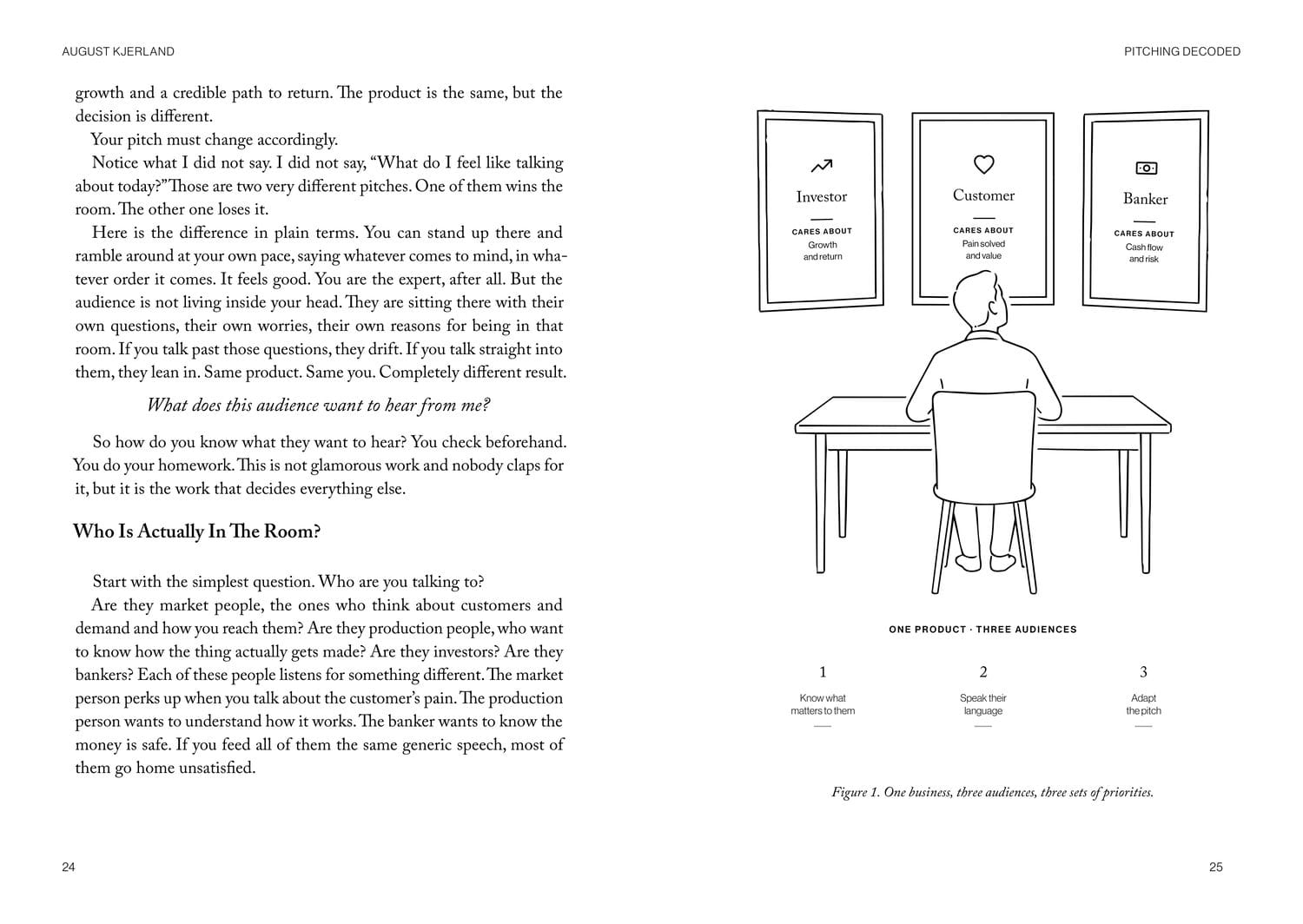
Then ask yourself one honest question. Does my pitch speak to these people, or to me?
If you are pitching abroad, add one more layer. Who is the most senior? Who controls the budget? Who can recommend and who can approve? More on that in How to pitch across cultures.
Before: check the deck
Run your deck against Guy Kawasaki's 10/20/30 rule. Count the slides. Time a full run out loud. Find every line below thirty point. Cut to one idea per slide.
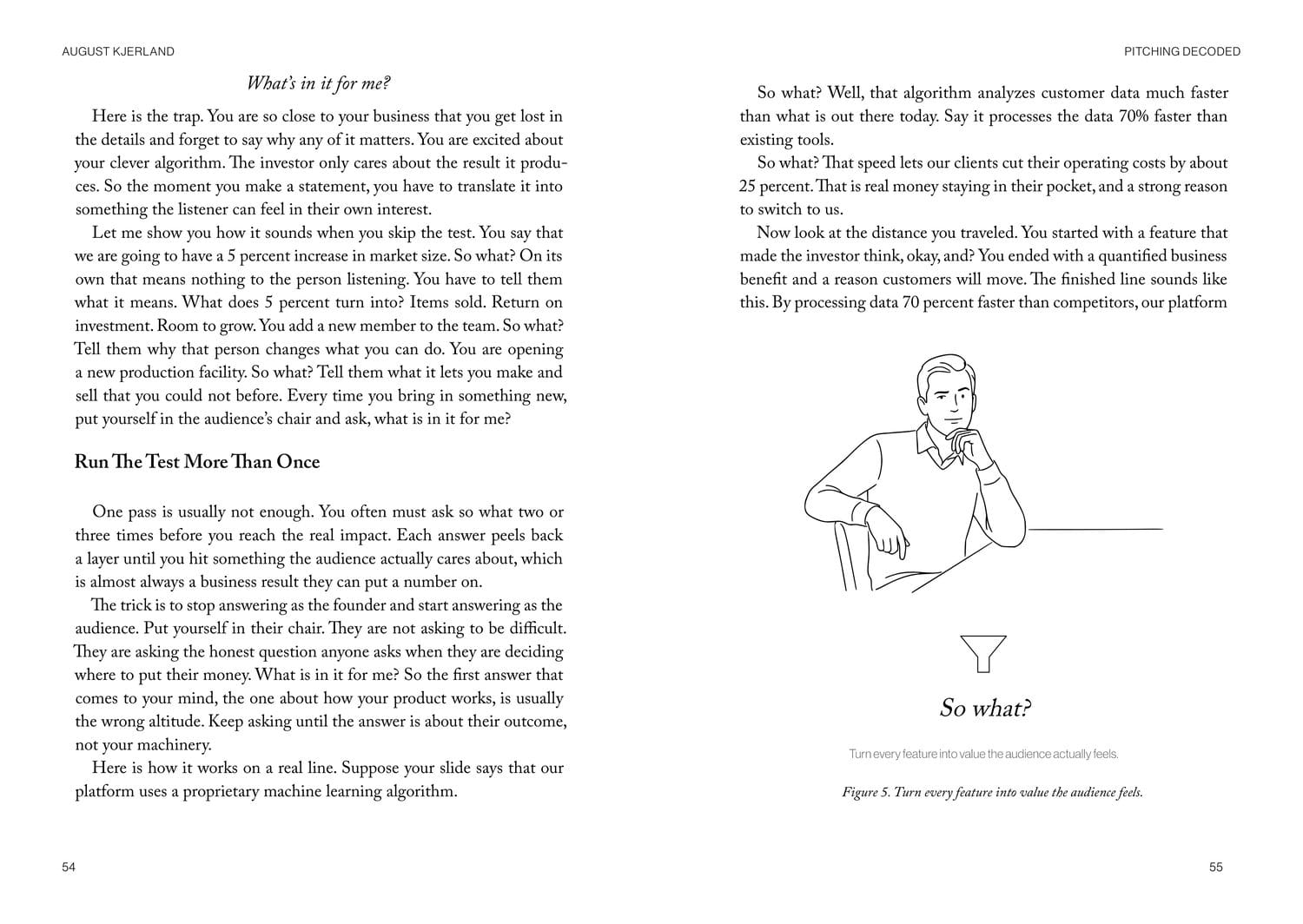
Then put every claim through Kawasaki's "So what?". If a slide cannot answer why it matters to the listener, it is not helping.
Before: rehearse like it matters
Nobody is born a great pitcher. I rehearsed one six-minute pitch in Copenhagen at least thirty times, five or six of them on video.
- Write your first and last thirty seconds word for word, and learn them. The opening earns attention. The ending earns the next conversation.
- Pitch for two minutes with no slides and record it. Every place where you reach for a slide in your head is a part you have not internalised yet.
- Film yourself and watch it once with the sound off. Score your voice, hands, eyes, movement and dress from one to five. Fix the lowest first.
- Time the full run. If they give you twenty minutes, aim for nineteen and a half.
- Practise in front of people. Your team, your friends, a mirror. Do not take the feedback personally.
Before: pack
I bring my own laptop. I bring the deck on a memory stick. And often I bring the whole thing printed on paper. Technology fails at the worst moment, and a backup plan is part of the pitch.
Dress for the room. Do not overdress and do not underdress. And wear something you feel comfortable in.
During: lead the room
Arrive first. Walk on, stop, and take in the room for a few seconds before you speak. It settles you, and it tells them you are in charge.
Lead with your slides, do not read them. Reading your slides aloud tells the audience you do not know your business. (I wrote more about this in How to present without reading slides.)
Use your voice and your eyes. Slow down when a number matters. Pause. Look at people, not at the screen.
Read the room. A pitch is a conversation with real people, not a recording you are playing for them. If they look confused, slow down. If they lean in, go with it.
Handle questions well. Listen to the whole question before you answer. Give the answer first, then the evidence. If you do not know, say so: "I do not have that figure with me, but I will send it this afternoon." If a question rests on a wrong assumption, acknowledge the concern before you correct it. And remember that questions are a good sign. They mean people are thinking about it.
Close clearly. This is what we are going to do. This is why you should support us. We would love to talk with you afterwards. Thank you. Then stop talking and listen.
After: earn the next conversation
A pitch rarely closes the whole deal. Its real purpose is to earn the next conversation, the next meeting, the next test or the next commitment. Measure success by movement, not by a signature on the day.
- Send what you promised. If you said "this afternoon", it goes this afternoon.
- Follow up at the right speed. In the US, slow follow-up kills momentum. In Japan, decisions are slow and collective, and pushing hurts you.
- Read the answer correctly. A Norwegian founder I write about in the book heard "Yes, this is very interesting" in Tokyo, and then nothing. That yes meant "we understand". At the second meeting he asked to continue rather than to close. "We would like to continue the discussion" was progress. The pilot was agreed two months later.
- After a no, keep your credibility. Some investors will say no. Your task is not to control every reaction. It is to leave the room with your credibility intact.
- Watch the recording. If you filmed it, watch it twice. Once with the sound off, once just listening. Then fix one thing before the next pitch.
The short version
Keep the deck simple. Know the numbers. Respect the audience. State the value. Make the ask. Then stop talking and listen.
Go further
Score your pitch for free. The Pitch Diagnostic checks your pitch against the red flags investors look for.
The course. How to Pitch: Precision in Every Detail takes you through the whole method in video, at your own pace. €49.

The book. The full pre-pitch checklist, the ten questions investors will ask and a ten-question clarity self-test are in the appendices of Pitching Decoded. Be first in line.
Watch it live. The replay and notes from my August session: How to Pitch So People Say Yes.
August’s Brief
Practical notes on entrepreneurship, pitching, and cross-cultural business. A few times a month. No hype.

Entrepreneurship. Decoded.
Practical entrepreneurship from an operator with forty years of executive and board experience. He teaches at BI Norwegian Business School and University of Agder.
© 2026 August Kjerland · Privacy Policy
Powered by August Kjerland & GMERK.