
How to Pitch So People Say Yes: the Replay and My Notes
How to Pitch So People Say Yes: the Replay and My Notes
On 27 August I went live on YouTube for fifty minutes on one question. Why do good businesses get polite nods instead of a yes?
If you missed it, the full session is below, questions and all. Underneath are my notes, so you can take the method with you without rewatching the hour.
Why pitches fail
Rarely because the idea is bad. In forty years on both sides of the table, I have seen three reasons over and over.
Preparation. The first hard question arrives and the whole thing wobbles.
Clarity. The founder is so close to the product that they forget to say why it matters.
Audience. The same pitch goes to an investor, a banker and a customer, unchanged.
A pitch has four jobs
A pitch is a decision tool, not a business plan. Every time, it has to do four things.
- Explain. What do you do?
- Matter. Why should I care?
- Prove. Why should I believe you?
- Ask. What happens next?
Miss one and the audience has to work too hard. Tired audiences do not say yes. They say "interesting".
The first exercise in the session was one sentence: We help ___ solve ___ so they can ___. If it needs a second sentence, it is not finished.
Structure: ten slides, twenty minutes, thirty point
Guy Kawasaki's 10/20/30 rule is still the best discipline I know. Ten slides force you to prioritise. Twenty minutes leave room for questions, and the questions are where the deal actually happens. Thirty point type means that if it does not fit, you do not know it well enough yet. The numbers are not sacred. The discipline is. (More on the rule in this post.)
The spine I use has two halves. Slides one to five are the logic: title, problem and opportunity, value proposition, the underlying magic, business model. Slides six to ten are the proof: go to market, competition, team, financials and metrics, status and the ask.
Trond is the case I used here. An engineering student with a good idea, sensors that warn small food producers before a temperature failure ruins their stock. He had eight minutes and twenty-seven slides. By slide six, four of his eight minutes were gone. The deck held almost everything the founders knew, except what the investor needed to know.
He rebuilt it around one question. What does the investor need to understand before deciding whether to meet us again? That is the whole point. A pitch is not a final agreement. It is how you earn the next conversation.
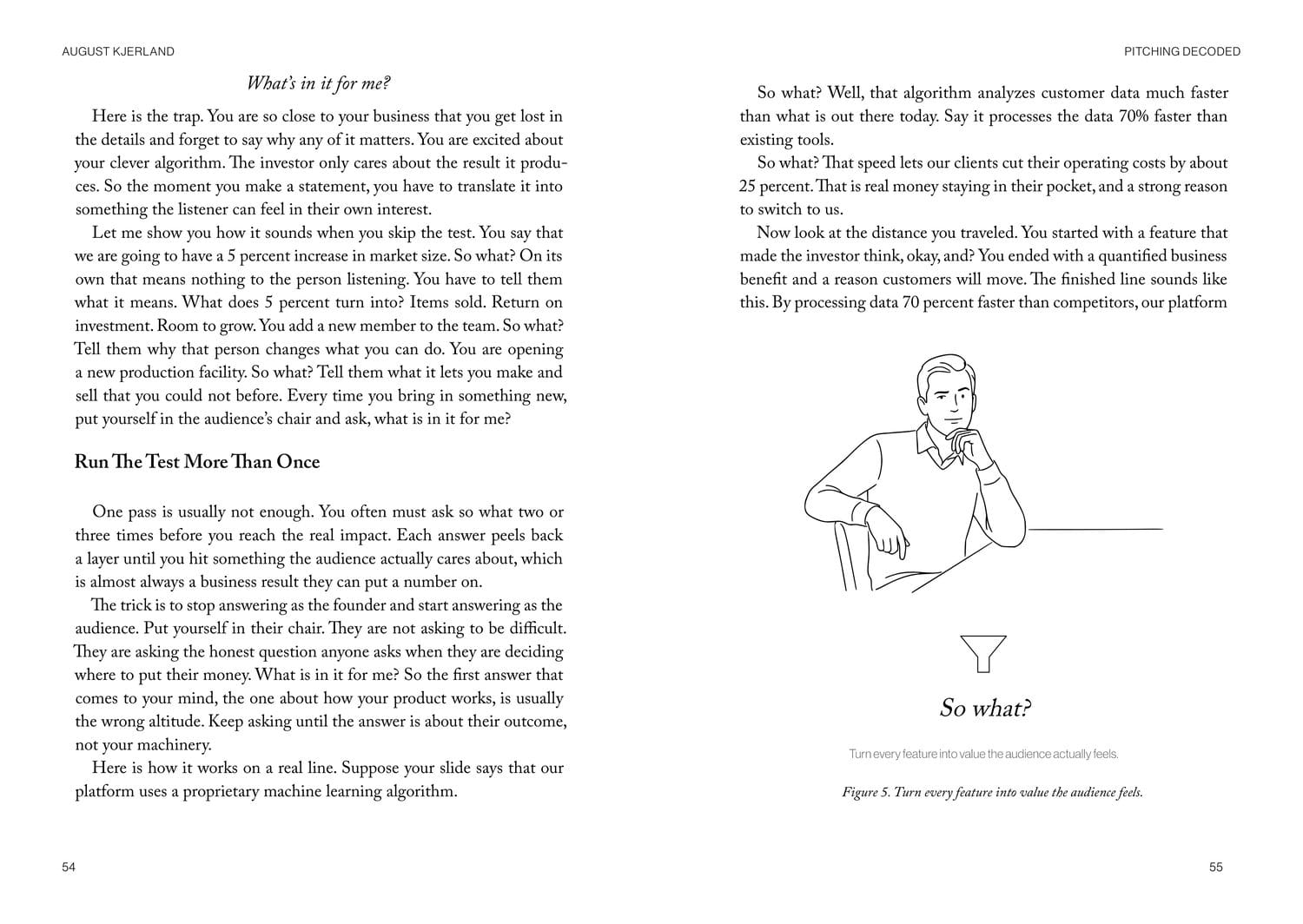
Value: ask "So what?" three times
Kawasaki also gave us the person on your shoulder who asks "So what?" after every claim. Ask it three times. The first answer is always about your machinery. The third is usually about their money.
- "A proprietary machine learning algorithm." So what?
- "It analyses customer data seventy percent faster." So what?
- "It cuts our clients' operating costs by about twenty-five percent."
Nobody funds a feature. They fund what the feature makes possible. A good claim has an effect, a number and a named beneficiary. "Our platform has many useful features" becomes "Our platform reduces manual work by thirty percent, which gives teams more time with customers."
Delivery: the part that is not on the slide
Emma had a recruitment platform with real customers and measurable results. Investors kept saying "interesting". She rebuilt her slides twice. Nothing changed.
Then an investor asked her why she could beat the larger platforms. She turned to the slide. The answer was not there. "Forget the slide," he said. "Tell me." Her thirty-second answer, in her own words, was the strongest part of the meeting.
Delivery cannot rescue a weak business. But poor delivery can hide a strong one. I think of it as four instruments:
- Voice. Slow down when a number matters, and let the silence work.
- Body. Stand still unless there is a reason to move. Nerves are not a reason.
- Eyes. Finish the sentence looking at a person, not at the screen.
- Dress. Neither over nor under. Read the room.
(I wrote more about the slides-versus-speaker problem in How to present without reading slides.)
The room changes the rules
Sometimes the pitch that wins is not in a meeting room at all. Years ago I worked with a company in Arendal that made deck machinery. We had been to Riyadh to negotiate with Saudi Aramco, and when their people came to Norway, we took them on a boat trip around Hisøy.
Somewhere around the lighthouse at Galtesund, the way they talked changed. Before, it was "maybe" and "possible". After, it was "when", "how many spare parts" and "what is the cost". Nobody said "you have the contract". But that turn of the boat was when it became ours.
The room also changes what your behaviour means. I lived in the United States for twelve years and travelled to Japan for many more. Five seconds of silence in a meeting in New York makes people restless. What is this pause about? Somebody should close this. In Tokyo, the same silence often means they respect what you said and want to think about it. Fill it and you interrupt.
Same behaviour, opposite meaning. I went deeper on this in an earlier session, written up in How to pitch across cultures.
One exercise for this week: the sixty-second pitch
You will not always get twenty minutes. Sometimes you get a lift or a coffee queue. Write five boxes, one sentence each.
- Problem. What pain or opportunity exists?
- Solution. What do you do?
- Value. Why does it matter to them?
- Proof. Why should they believe you?
- Ask. What happens next?
Read it out loud once. If any box needs a second sentence, it is not finished.
Before your next pitch
- Can the audience explain what you do in one sentence?
- Have you answered "So what?" after every major claim?
- Do your slides support you, or replace you?
- Are the numbers few, simple and honest?
- Is the next step unmistakable?
The full checklist for before, during and after the meeting is in How to prepare for a pitch, and the questions you should be ready for are in the questions investors ask.
A pitch is not about saying more. It is about making the right decision easier.
Go further
The course. How to Pitch: Precision in Every Detail is the longer version of this session, at your own pace. The full ten-slide method, delivery, the hard questions and the close. €49.
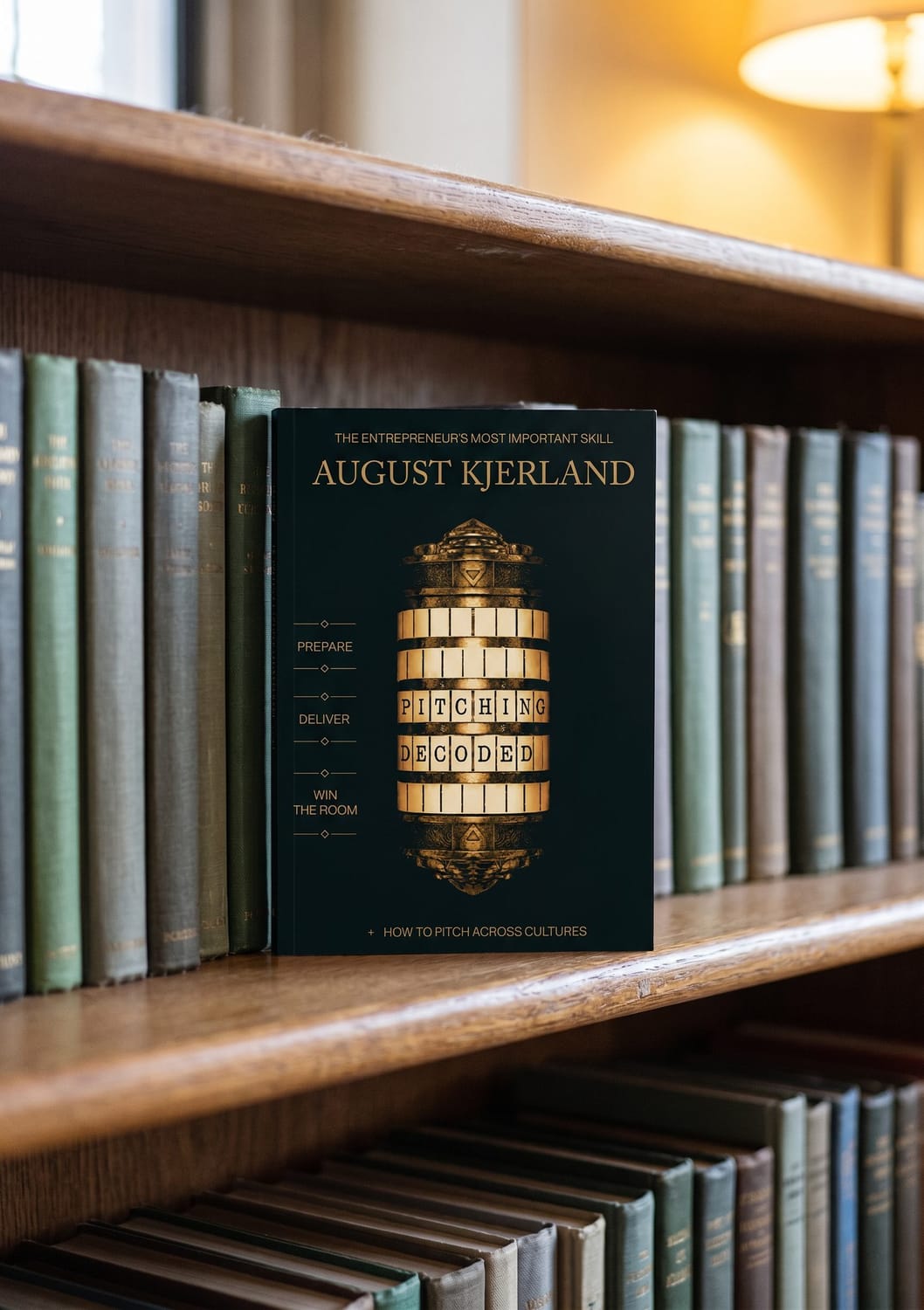
The book. Trond and Emma are two of the cases in Pitching Decoded, together with the templates and checklists. Be first in line.
August’s Brief
Practical notes on entrepreneurship, pitching, and cross-cultural business. A few times a month. No hype.

Entrepreneurship. Decoded.
Practical entrepreneurship from an operator with forty years of executive and board experience. He teaches at BI Norwegian Business School and University of Agder.
© 2026 August Kjerland · Privacy Policy
Powered by August Kjerland & GMERK.