
How to Present Without Reading Slides: A Founder's Guide to Credibility
How to Present Without Reading Slides: A Founder's Guide to Credibility
How to Present Without Reading Slides: A Founder's Guide to Credibility
You have ten minutes to convince a room of investors that your company is the future. Your pitch deck is polished. Your data is solid. You step up, the first slide appears on the screen, and you begin to speak.
But you are not speaking to the investors. You are speaking to the screen. You are reading your bullet points, one by one. With every word you read, you lose a fraction of the room's attention. With every slide you narrate, you chip away at your own credibility.
This is the single fastest way to lose an audience. Whether you are in a boardroom, on a stage, or in a critical sales meeting, the moment you become a narrator for your own PowerPoint, you cease to be a leader. You become an administrator.
The ability to present without reading slides is not a "soft skill." It is a fundamental indicator of preparation, confidence, and authority. It signals that you have internalized your subject so deeply that the slides are merely a backdrop for the value you provide. This article provides a practical framework to help you stop reading your slides and start commanding the room. We will not cover theory or motivational fluff. We will cover structure, preparation, and execution: the three pillars of a powerful presentation.
The Fundamental Misunderstanding: The True Purpose of Your PowerPoint Slides
Many founders and executives treat their slide deck as a comprehensive document, a script to be followed from start to finish. This is the first and most critical error.
A slide has one primary job: to support the speaker by providing a visual anchor for the audience. Its purpose is to illustrate a point, display data, or simplify a complex idea. It is a tool for the audience’s comprehension, not a teleprompter for the presenter’s memory.
When you read your slides aloud, you create a cognitive conflict for everyone in the room. You are asking them to perform two tasks simultaneously: read the text on the screen and listen to you saying the exact same text. The human brain is not efficient at this. Invariably, the audience will tune you out and simply read ahead, waiting for you to catch up. The connection is broken. Your pacing is dictated by the text, not by the flow of your argument or the reaction of the room.
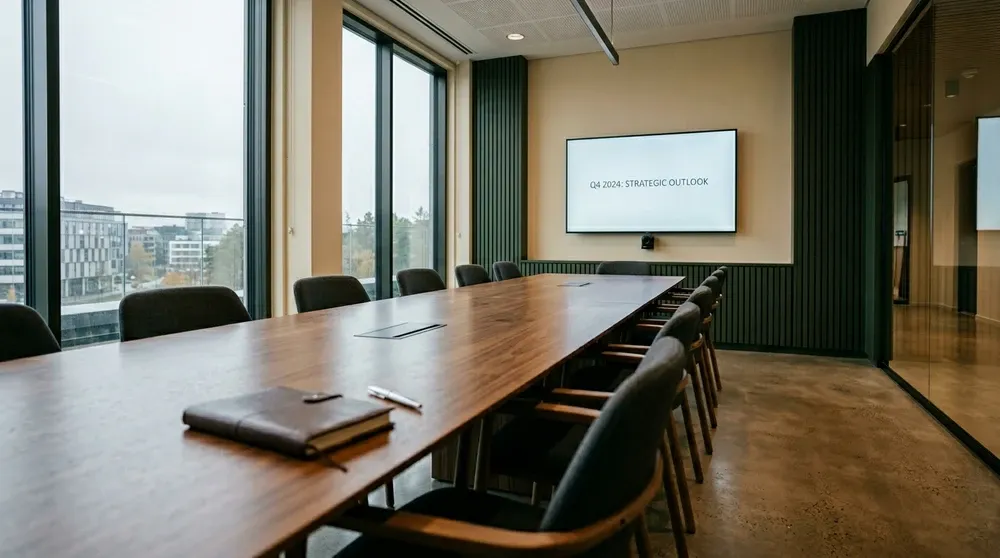
So what?
The "so what" is this: a presentation is an act of transference. You are transferring confidence, information, and conviction to your audience. When you hide behind your PowerPoint slides, you transfer nothing but text. You signal that you don't know your material well enough to discuss it, and if you don’t have mastery over your own business, why should anyone invest their time or money in it?
A good presenter uses a slide to make a single, powerful point. A weak presenter uses a slide to remember what to say next.
The Root Cause: Why Speakers Read Slides
The habit of reading slides is not a symptom of poor public speaking skills. It is a symptom of inadequate preparation. It is a safety net for a speaker who fears they will forget a key point, miss a critical number, or lose their train of thought.
The solution is not to simply "be more confident." The solution is to prepare in a way that makes the safety net unnecessary. True preparation is not about memorizing a script; it is about internalizing a narrative.
From Script to Structure: Mastering Your Core Narrative
Memorizing a speech is brittle. One forgotten word can derail the entire presentation. A far more robust approach is to master your structure and your key messages.
For any given presentation, you should be able to articulate:
The One-Sentence Objective: What is the single most important thing you want your audience to think, feel, or do after you finish speaking?
The Three Key Pillars: What are the three main arguments or sections that support your objective?
The "So What" of Each Slide: For every single slide in your deck, you must be able to answer the question, "Why is this here, and what does it mean for the audience?"
Instead of writing and memorizing paragraphs of text, focus on internalizing these "anchor points." Your goal is to be able to have a conversation about any given slide, not to recite its contents. This approach gives you the freedom to adapt, to answer questions, and to connect with your audience in a genuine way. You can speak without a rigid script because you understand the underlying logic of your argument.
The Proper Use of Speaker Notes and Presenter View
Technology can be a crutch or a tool. Tools like Presenter View in PowerPoint or Keynote are designed to help you, but they are often misused. Many presenters fill their speaker notes with the very paragraphs they are trying to avoid reading from the screen. They simply trade one teleprompter for another.
This is a mistake. Effective speaker notes should contain prompts, not a script.
Use your speaker notes for:
Key Data Points: Specific numbers, dates, or statistics you must get right. (e.g., "CAGR: 28%")
Transitions: A short phrase to bridge the gap between one slide and the next. (e.g., "This market potential leads to our specific go-to-market strategy...")
Questions to the Audience: A reminder to engage the room. (e.g., "Ask: Has anyone encountered this bottleneck before?")
Timing Cues: A note to yourself about pacing. (e.g., "Spend ~2 mins here.")
Keep your notes brief. Think of them as signposts on a journey you already know well, not a turn-by-turn GPS navigator. They should be glanceable, allowing you to maintain eye contact and presence with the room. A quick glance at a single bullet point should be all you need to trigger your next talking point.
A Tale of Two Pitches: The Impact of a Presentation Without Reading
Imagine two founders pitching the same company with the same slide deck. The only difference is their delivery.
The Presenter Who Reads the Slides
Our first founder, let's call him Alex, steps up. The slide on the screen is titled "Our Unfair Advantage." It has three bullet points:
Proprietary AI algorithm with 94% predictive accuracy
Exclusive 3-year distribution deal with a major industry partner
Founding team with 40+ years of combined domain experience
Alex turns slightly toward the screen. "Our unfair advantage is threefold," he begins, his eyes locked on the projection. "First, we have a proprietary AI algorithm with 94% predictive accuracy. Second, we have an exclusive three-year distribution deal with a major industry partner. And third, our founding team has over 40 years of combined domain experience."
He clicks to the next slide.
The Result: The information was delivered, but there was no impact. The investors read the points faster than Alex said them. They are now checking their phones, waiting for him to finish. Alex demonstrated that he can read, but not that he can lead. By failing to provide context or conviction, he made his "unfair advantages" sound like a generic checklist. It is a really bad way to build trust.
The Speaker Who Commands the Room
Now, consider our second founder, Sarah. The same slide appears.
Sarah stands confidently, facing the investors. She makes eye contact with the lead investor on her left.
"There are three core reasons why we are uniquely positioned to win this market," she says, her voice calm and measured. She gestures towards the screen with an open hand, briefly referencing the first bullet.
"It starts with our technology." She turns her focus to an investor on her right. "Our algorithm isn't just another tool; it delivers 94% predictive accuracy in our trials. For our customers, this means reducing material waste by an average of 17%. That's a direct impact on their bottom line."
She pauses, letting the number sink in.
"But great tech is useless without access. We've secured an exclusive three-year distribution contract with the largest partner in the sector." She looks back to the center of the room. "This isn't a pilot program. It's a commitment that gives us immediate access to over 5,000 target customers from day one."
Another deliberate pause.
"Finally, it comes down to the team. My co-founders and I have spent a combined four decades solving this exact problem for other companies. We've built the relationships, we know the pitfalls, and we have the trust of the industry."
The Result: Sarah did not read your slides. She used them as punctuation for her story. She translated each feature into a direct benefit or a strategic asset. She exuded mastery and conviction. The investors are not just informed; they are engaged. They believe her because she clearly believes and understands what she's saying. She showed them respect by preparing properly.

Practical Techniques to Stop Reading and Start Speaking
Shifting from reading to speaking requires a deliberate change in your preparation process. Here are concrete techniques you can implement immediately.
Adopt the "One Slide, One Idea" Principle
Complexity is the enemy of clarity. If you find yourself cramming five different ideas onto a single slide with dense bullet points, you are building a document, not a presentation aid. This forces you to spend too much time explaining the slide itself and tempts you to read it just to make sure you cover everything.
Adopt a strict "one idea per slide" rule.
If you have a slide with three distinct benefits, break it into three separate slides.
If you have a complex chart, dedicate one slide to the chart itself and a subsequent slide to the single most important conclusion you want the audience to draw from it.
This approach forces you to simplify your message. It also makes your presentation more dynamic and keeps the audience focused on the point you are making in that exact moment. A clean, simple slide is easy to glance at, freeing you to focus on the audience.
Rehearse with Intent, Not for Memorization
The goal of rehearsal is to internalize your narrative, not to memorize a script. Here’s a structured way to practice:
The "No-Slides" Talk-Through: Before you even look at your deck, talk through your entire presentation out loud. Explain your business, the problem, the solution, the market, and the ask as if you were speaking to a colleague over coffee. This helps you find your natural language and solidify your core story.
The "Anchor Point" Rehearsal: Now, go through your slides one by one. For each one slide, state its single core message or "anchor point" out loud. Don't give the full speech, just the central idea. This connects your narrative to your visuals.
The Full Dress Rehearsal (Recorded): Finally, do a full run-through with slides, a clicker, and a timer. Record yourself on video. Watching yourself back is one of the most powerful, and uncomfortable, learning tools. You will see exactly when your eyes drift to the screen, when your energy drops, and when your message becomes unclear.
Master Your Physical Presence
How you stand and move speaks volumes. When you present without being tied to a screen, your body language becomes a powerful tool.
Stance: Stand with your feet shoulder-width apart. This creates a stable, grounded base that projects confidence. Avoid shifting your weight or rocking.
Eye Contact: Do not scan the room like a security camera. Connect with one person for a full thought or sentence, then move to another person in a different part of the room. This makes your presentation feel like a conversation.
Gestures: Use purposeful, open-hand gestures to emphasize points. Keep your hands out of your pockets. Hold your clicker in one hand, but don't let it become a fidget toy.
Movement: Do not pace aimlessly. If you move, do it with purpose. For example, take a step forward to emphasize a key point or walk to a different part of the stage to signal a transition to a new section.
The 60-Second Challenge: Your First Step Today
Action builds skill. Here is a simple exercise you can do right now to begin breaking the habit of reading slides.
Choose one slide from your most important presentation deck.
Set a timer for 60 seconds.
Stand up and turn your back to your computer screen.
For 60 seconds, explain the core message and the "so what" of that slide out loud. Use your own words.
When the timer goes off, review what you said.
Do this three times with the same slide. You will notice that each time, your explanation becomes clearer, more concise, and more confident. You are training your brain to retrieve the idea, not the text.

Build Your Presentation on a Solid Foundation
A confident delivery cannot fix a broken story. The ability to speak without relying on your slides comes from an unshakeable belief in the logic and clarity of your core message. When your narrative is weak, you will cling to your slides as a crutch. When your narrative is strong, the slides become secondary.
This work begins long before you choose a font or a color palette for your deck. It begins with structuring your core arguments in a way that is clear, compelling, and persuasive. For any founder, owner, or executive, the investor pitch is the ultimate test of this structure.
Reading the room matters even more across borders. See how high-context vs low-context culture changes what presence means.
To help you build this essential foundation, I have developed the 10/20/30 Pitch Deck Blueprint. It is a free, practical guide that breaks down the ten essential slides you need, the twenty-minute structure to follow, and the thirty-point font rule for clarity. It provides the framework you need to build a powerful narrative.
Download the free blueprint today. Build your foundation, master your story, and step in front of your next audience ready to lead, not just to read.
Related reading: if your slides still aren't landing, see why most pitch decks fail and the 10-20-30 rule for a deck that holds attention.
Keep reading
- How to Pitch So People Say YesThe replay and notes from my live session on pitching.
- How to Prepare for a PitchA checklist for before, during and after the meeting.
August’s Brief
Practical notes on entrepreneurship, pitching, and cross-cultural business. A few times a month. No hype.

Entrepreneurship. Decoded.
Practical entrepreneurship from an operator with forty years of executive and board experience. He teaches at BI Norwegian Business School and University of Agder.
© 2026 August Kjerland · Privacy Policy
Powered by August Kjerland & GMERK.