
How to Pitch Across Cultures
How to Pitch Across Cultures
The same slides, the same facts and the same person can win in one country and stall in the next. I have watched it happen for forty years. Twelve of them living in the United States, many more selling technical products and food into Japan, and a lot of meetings in between.
In June I ran a free live session on exactly this. The full recording is below. Underneath are my notes, so you can use them before your next meeting abroad.
Build the pitch first. Then adapt it.
Culture is not where you start. First build a pitch that works, test it, and only then ask how the room you are walking into will hear it.
A pitch that works is not a presentation of you. It is support for their decision. Every instinct you have as a founder has a mirror on the other side of the table.
- You want to tell your story. The customer wants to know how you solve their pain.
- You want to talk about the product. The investor wants to know the risk.
- You want to talk features. They want to know the upside.
- You want to explain how hard you worked. They want to know what they are deciding.
So your first job is not to explain. It is to choose the listener's door. Investors look for risk and upside. Customers look for pain and outcome. Partners ask whether this fits their market, and whether they can trust you.
Then run every claim through Guy Kawasaki's "So what?". "We grew forty percent last quarter." So what? From what? Put the number in context and say what it means for them. Keep the discipline of 10/20/30. And stop at the end and make the ask. How to get ready for all of that is in How to prepare for a pitch.
Why good pitches break abroad
Not because you are bad, or the pitch is bad. What sounds clear in the US can sound too direct in Japan. Confidence in one room reads as looking down on people in another.
Edward T. Hall described culture as an iceberg. You only see the tip. Words, accent, eye contact, voice, posture. Just below the water sit implied meaning, hierarchy and whether people think as individuals or as a team. Deeper still, how they see time, urgency, respect and what it means to be professional.
Optimise your pitch for the visible tip and you optimise for the wrong thing.
Six norms that run the room
Directness. How blunt is too blunt? Even inside Norway it differs. Bergen is direct, the south is not. In Japan much is said through hints. You have to get onto their frequency.
Silence. Americans get restless after a few seconds. In Japan silence is often reflection, and can be a good sign.
Formality. First names and a hug in the US. Not in Japan. Personal space is much smaller in America.
Hierarchy. Who can challenge whom? In Japan I sat opposite my counterpart at my own level. The presidents at the end of the table rarely spoke.
Public clarity or private care. Some issues you raise in the meeting. Others you raise quietly in the break. I once took a Japanese counterpart aside and asked him to keep one point out of the discussion. He thanked me, and took it to his president.
Decision speed. The American decides fast and has other vendors waiting. The Japanese team decides by consensus, often outside the room. Norway sits somewhere in between.
For the theory of high and low context itself, see High-Context vs Low-Context Culture. Here is what it does to a pitch.
Clear according to what?
In a low-context room you say the point and name the ask. "We need ten million for forty percent of the company, and these are the three next steps."
In a high-context room, naming the ask in the first meeting can offend. Disagreement comes indirectly, through references to earlier situations. The ask comes later. Maybe tomorrow.
So the question is not only "was I clear?". It is "clear according to what?".
Relationship before contract
In low-context cultures the relationship starts when you have the contract. In high-context cultures you do not get the contract until the relationship exists.
Jumping straight to terms may sound efficient to you. To them, you have skipped the consensus. The order that works is trust, understanding, proof, proposal, terms. Do not be impatient. If you do not have the trust, you have nothing.
Reading the room
Silence can be a thoughtful signal. Or it can mean you went too far, too fast. Do not lose the room. If you feel it slipping, ask for a coffee break.
Watch who speaks, who decides and who carries the message back. You can disagree anywhere, but how you disagree decides whether the other side keeps face. And if the people you expected to speak stay quiet, step back, rephrase and move on.
Every meeting is a new meeting.
On my second trip to Japan, a man I already knew handed me his card. I put it straight in my shirt pocket. I had missed that he had been promoted. They will not brag, but they will show it in the business card.
Adapting for Japan
- Send material early, so the team can align before you arrive.
- Slow down, and speak through facts. Do not claim what you cannot prove. They will check it.
- Respect hierarchy and the business card.
- Seek group consensus, not personal assertion.
- Follow up with a careful summary while trust is fresh.
My colleague's advice before my first trip still holds. Remember that you are a guest, and behave like one.
Adapting for the US
- State the main point early.
- Show return on investment and traction.
- Be clear, confident and concrete, and keep eye contact.
- Expect direct challenge. An American customer once told me we were not delivering. I told him he had changed the product. It was a good discussion. In Japan that conversation would never have happened in the room.
- Close with the next step, an owner and a timeline.
Japan and the US side by side
| Japan | United States |
|---|---|
| Trust first | Value first |
| Context and process | Clarity and momentum |
| Consensus travels outside the room | Decision pushed in the room |
| Avoid loss of face | Expect direct challenge |
| Follow-up confirms understanding | Follow-up locks action |
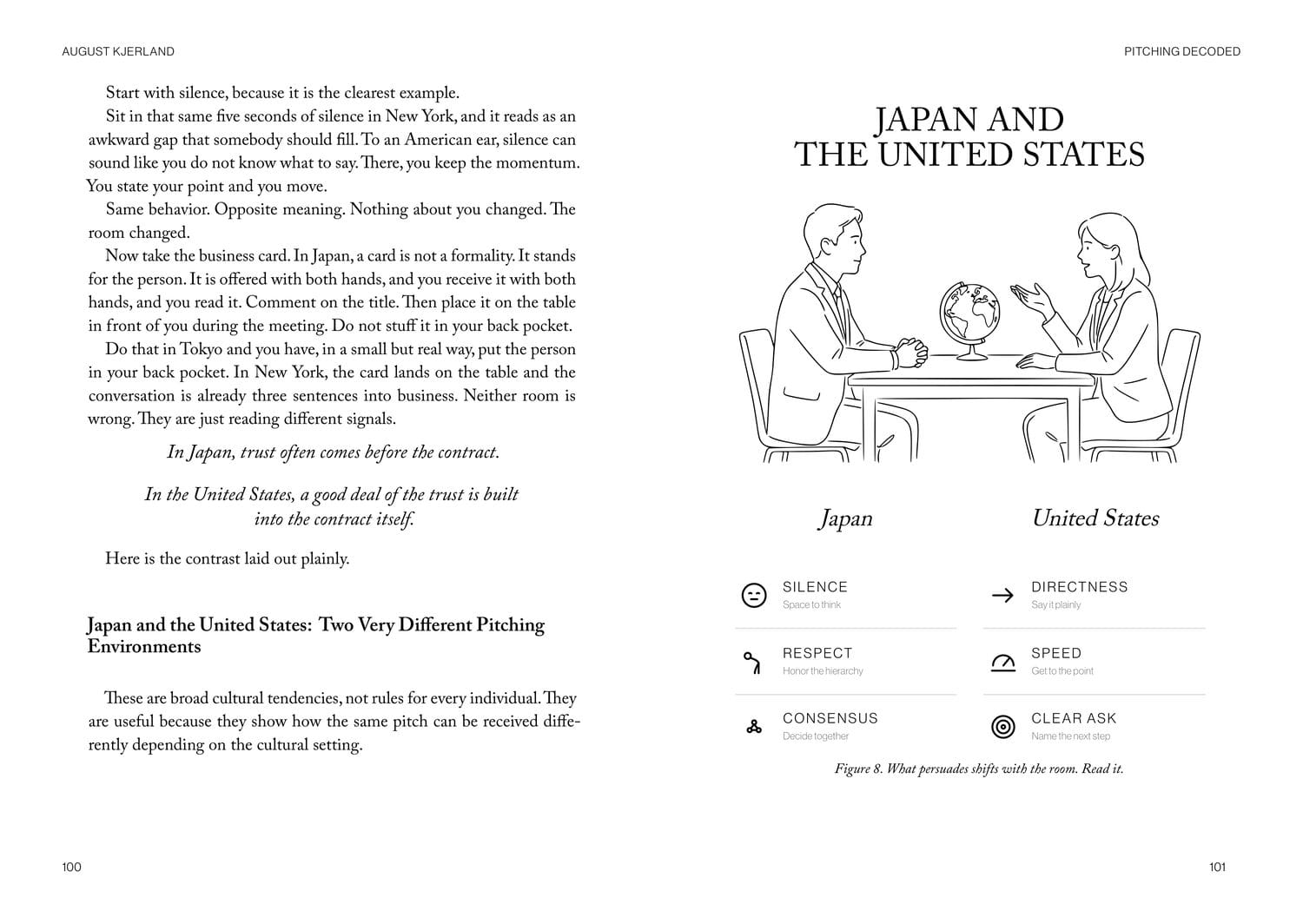
Neither is right or wrong. They are different, and you are the one who has to adapt.
Four things to take with you
- Do not pitch your story. Pitch their decision.
- Answer "So what?" before they ask it.
- Read the culture before you read the room.
- Adapt the route, not your integrity.
Go further
Free: the Cross-Cultural Negotiation Playbook, the PDF I give every founder doing business abroad.
The course: Cross-Cultural Communication, six lessons at your own pace, with Japan, the US and the rest of the map. €49.
On pitching itself: the replay and notes from my August session, How to Pitch So People Say Yes.
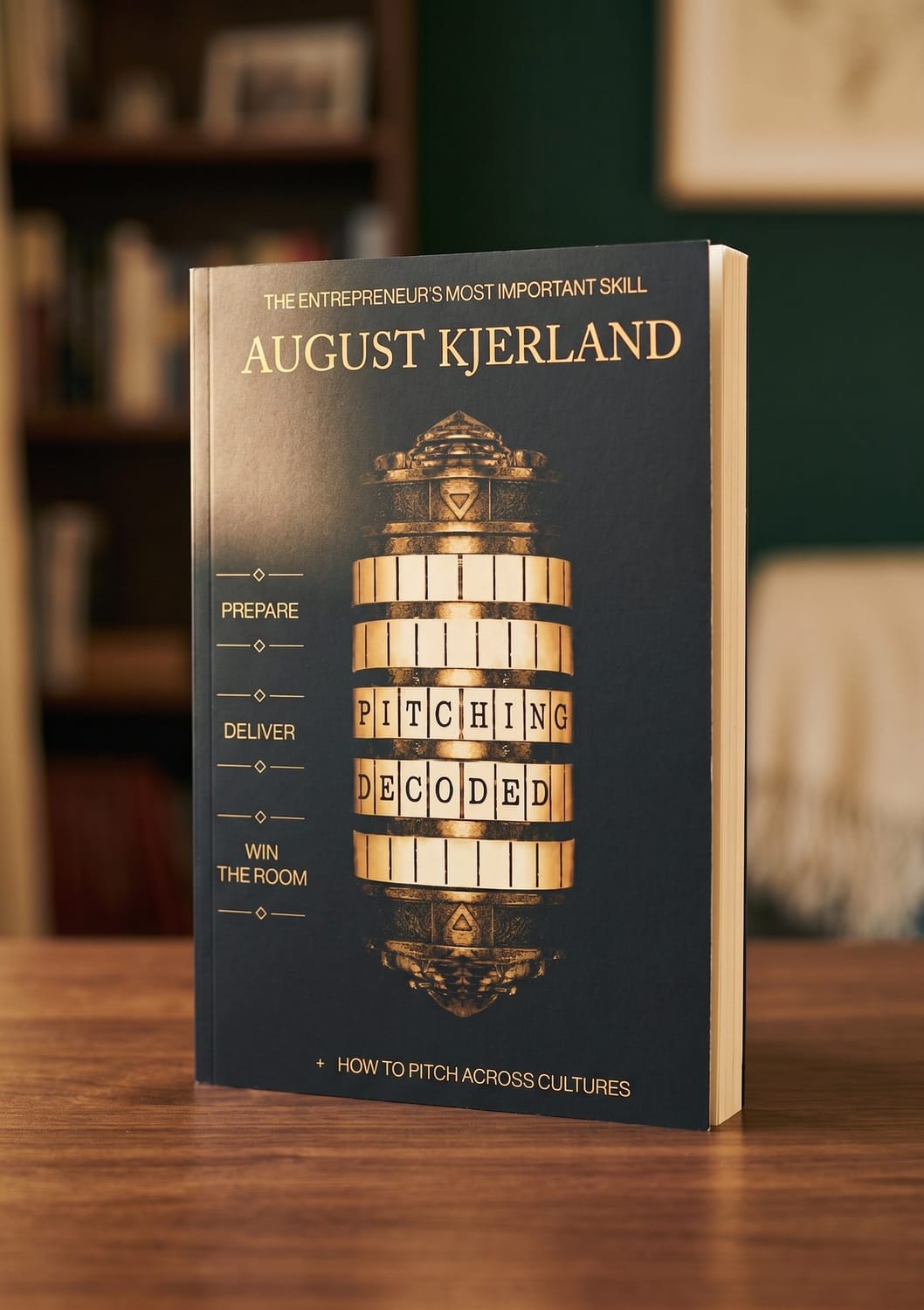
The book. The Japan and US comparison, the cheat sheet and the cases behind these notes are in Pitching Decoded. Be first in line.
Pitching into a new market soon? Talk to me.
August’s Brief
Practical notes on entrepreneurship, pitching, and cross-cultural business. A few times a month. No hype.

Entrepreneurship. Decoded.
Practical entrepreneurship from an operator with forty years of executive and board experience. He teaches at BI Norwegian Business School and University of Agder.
© 2026 August Kjerland · Privacy Policy
Powered by August Kjerland & GMERK.